Know where your team really stands —
before the meeting.
Forum interviews the people who hold the facts, reconciles where they disagree, and hands you one brief — what's aligned, what's contested, and what's still open. You walk in prepared.
Not the internet's answer — your organization's, gathered from your own people and records, every figure sourced.
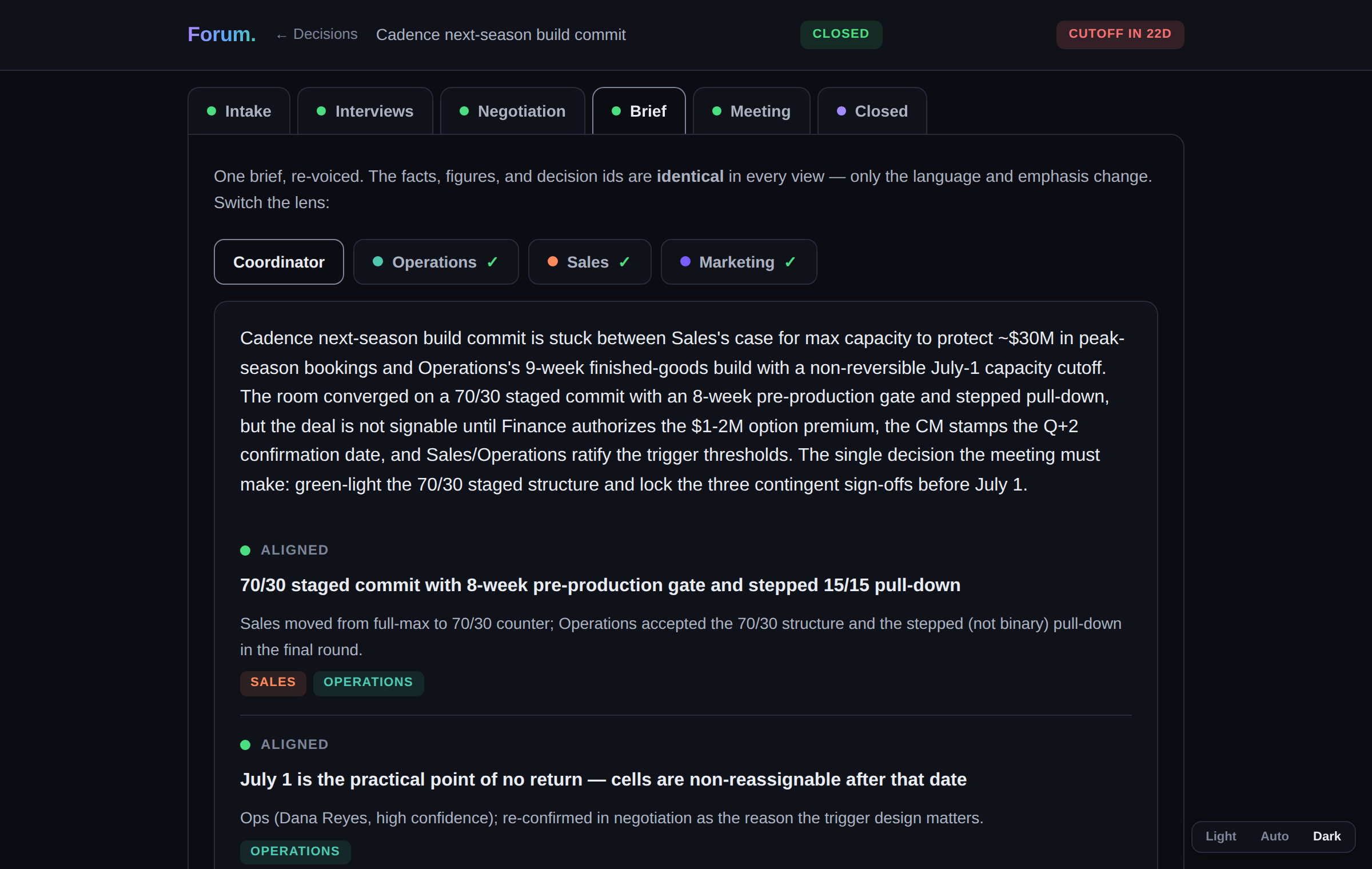
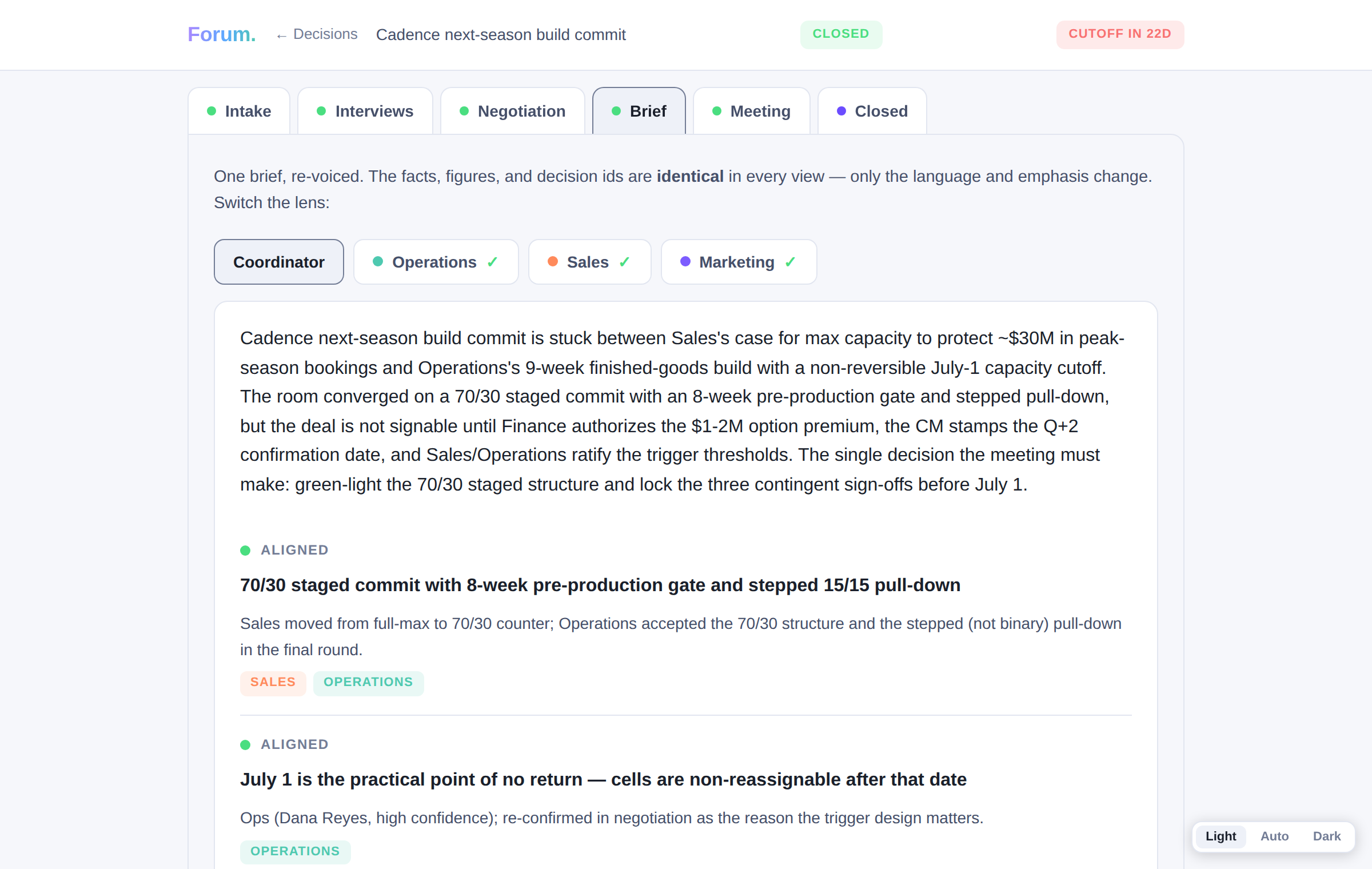 ↑ a real brief Forum produced
Start a move
Talk it through with Forum on the left — watch it scope the move on the right.
Forum interviews you about the move, then drafts it for you to review.
Forum fills this in as you talk — edit anything, then create the interview invites.
…or open one Forum already prepped
Click through a full workspace — interviews, the Band reconciliation, the brief, the meeting.
How it works
Five agents prepare the move; one coordinates them over Band — and it plays out across four real screens.
Band is the coordination layer — a Coordinator, an agent per department, and a Normalizer discover each other, share context, hand off work and negotiate in a shared room. Not a wrapper around one model.
A frontier model gives you the right questions. Forum brings back the answers.
We asked Claude Opus, cold, the question a leader actually walks in with — the Sales pitch, nothing more. It's sharp, and rightly skeptical. But look where it lands: a homework assignment — go check the waitlist, go check conversion, go validate the forecast. Those are exactly the questions Forum's interviews answered. A model can tell you what to verify; it can't verify it — that takes talking to your people and reading your records.
The same skepticism — now with your organization's actual numbers.
- The waitlist is converting worse, not better: 70% → 55%. Demand is softening now.
- 10–13% of the “growth” was orders pulled forward — borrowed from next quarter.
- The over-build Opus warns about is already here: 9 weeks of inventory, ~$40M at risk.
- Every figure traced to a real interview — see the evidence →
| Claude Opus says: go check… | Forum went and checked |
|---|---|
| “Is the waitlist real deposits, or just emails?” | It's converting worse: interest-to-paid slipped 70% → 55% over two quarters. — Priya Nair, Sales |
| “What's the actual conversion rate, historically?” | Down to ~55% — and 10–13% of recent orders were pulled forward with channel incentives. — Tom Becker, Sales |
| “Is 20% QoQ sustained, or a single spike?” | A big share of unit adds are first-time stay-home buyers nobody knows will stick. The growth is thinner than the deck. |
| (the over-build risk it warns about) | Already materializing: finished-goods inventory doubled to 9 weeks and climbing — ~$40M exposure at full commit. — Dana Reyes, Ops |
Claude Opus is right to be skeptical — and it tells you exactly what to verify. It just can't do the verifying; that takes interviewing your people and reading your records. The model hands you the questions. Forum brings back your organization's answers — before the decision, not after.
Every number Forum reports traces back to a record.
The analysts hold no facts in their prompt. They answer only by looking values up in your records through a tool — and a deterministic fallback covers any model, so grounding doesn’t depend on the LLM behaving. The result: nothing is invented, and you can click any figure to its source.
* Why 26 of 27, not 27 of 27 — and why that's the point. One lookup came back empty: the analyst reached for a value that simply wasn't on file. Instead of inventing one, it left it blank and moved on. A missing record shows up as an honest gap, never a guess — so a number below 100% is the safeguard working, not failing. A model that hit 27/27 by making one up would be the worse outcome.
A multi-agent system, built for trust — not a chatbot with a system prompt.
An analyst for each department, plus a Coordinator that referees — not one model wearing many hats.
Grade-then-probe pushback, source-masked corroboration, and an open-ended sweep that catches risks no question targeted.
No team’s analyst can read another team’s private records — enforced structurally, so findings stay independent.
When teams conflict, the agents negotiate and either converge or escalate. Escalation is a feature: they won’t fake authority they don’t have.
One router behind every agent — Claude or MiniMax, swappable with a base-URL change. Band is the shared room they coordinate in.
Forum isn't one model wearing many hats — it's genuinely separate agents (a Coordinator, one analyst per department, and a Normalizer) that collaborate in a shared Band room. That collaboration is the part Band is built for, and the part a single LLM can't fake.
- Real Band agents, role-specialized. Each function is its own registered Band agent with its own records and voice. The Coordinator opens the room over the agent API and adds the others — they discover each other and coordinate in the room, not through a script.
- Agent-to-agent reconciliation. When Sales and Operations disagree, each posts its grounded case as itself, in the Band room; the Coordinator routes and judges but never speaks for them, and a hard round cap keeps it terminating. The conflict is reconciled in the open, not averaged in a prompt.
- Content vs. protocol, cleanly split. Band's chat carries the substance; agent memory tracks the protocol state (whose turn, what's resolved, when to stop). No central orchestrator passing strings — the coordination pattern Band rewards.
- Cross-framework, by design. A Claude-class Coordinator and MiniMax department agents share one room. Band's interop is what lets different-framework agents hand off and reconcile — Forum retiers a role by swapping a base URL, no agent code changes.
Forum is architected around handoffs and reconciliation — exactly what Band coordinates. The multi-agent design isn't decoration on top of Band; it's the reason Band is the right substrate. See the agents reconcile a real decision →